
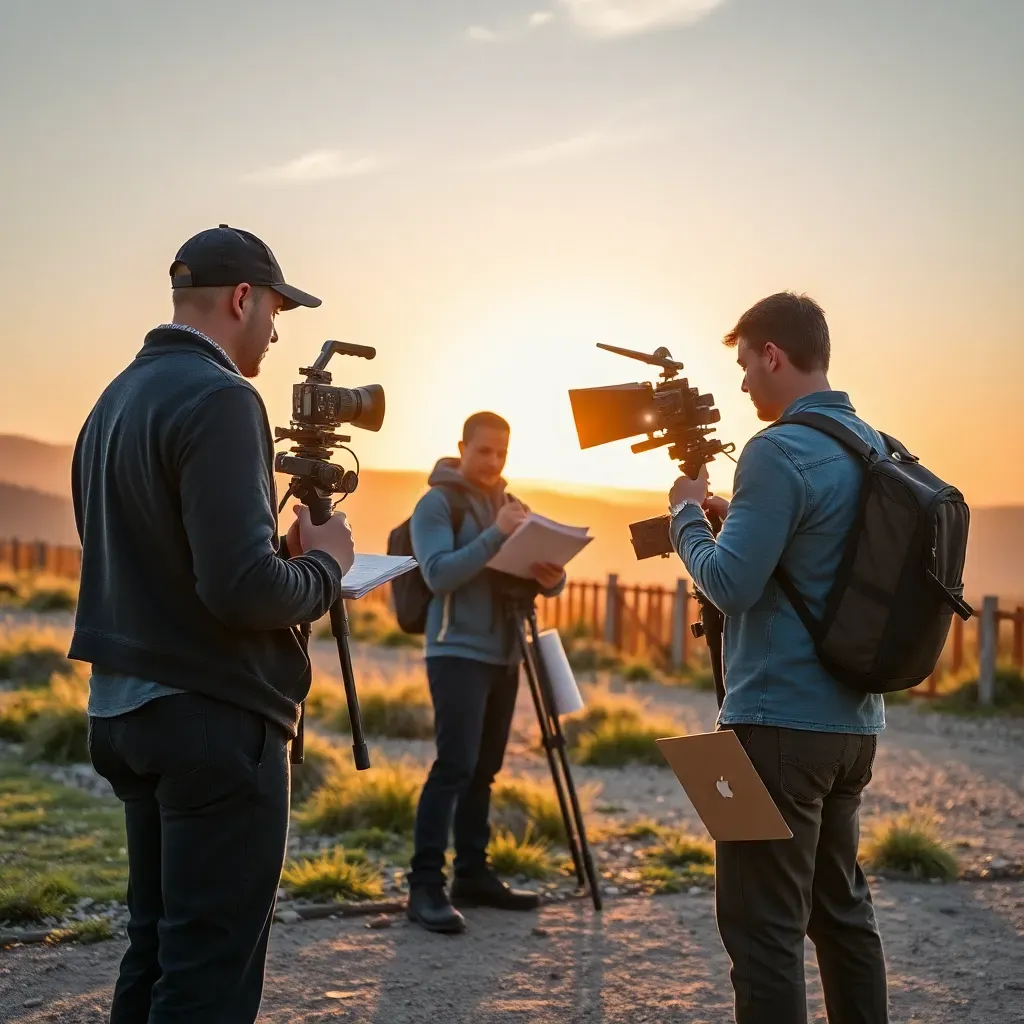
What Is a Film Fixer? A Production Guide for Filming in Australia
From outback deserts to harbour-front cityscapes, Australia draws international productions with world-class incentives and diverse locations. Here is what a film fixer actually does, why the role matters, and how to find one for your Australian shoot.
Ask ten people in the film industry what a fixer does. You will get ten slightly different answers — which is part of the problem. A film fixer is, at its simplest, a local production pro who bridges the gap between a global crews and the realities of shooting in unfamiliar area. In Australia, that area spans six states, two areas, a federal incentive system administered by Screen Australia, and state-level film offices from Screen NSW in Sydney to Screen Queensland on the Gold Coast. A fixer operating here needs to know not just locations and logistics. But a layered incentive framework that can return up to 40 per cent of qualifying spend to the right production. This guide breaks down what fixers do, when hiring one makes the difference between a smooth shoot and a costly mess, how the role compares to line producers and coordinators, what influences pricing, and how to review candidates before you commit.
As Fixers in Australia, we bring local expertise to international productions filming in Australia. Our team's deep knowledge of local regulations, crew networks, and production infrastructure ensures your project runs smoothly from pre-production through delivery.
ACT 01
What Is a Fixer?
The Local Expert Behind Every Successful International Shoot
A film fixer is a local production pro who sets up the logistical, administrative, and cultural needs of global crews filming in their country. The term crossed into film from journalism, where correspondents relied on local operators to arrange access and handle unfamiliar ground. Film adopted the concept and expanded it a lot. In Australia, a fixer might handle anything from securing a permit to close a lane of the Sydney Harbour Bridge to arranging camel wranglers for a desert shoot outside Coober Pedy.
- Fixers carry deep knowledge of local rules, locations, crew networks, and supplier relationships
- They act as the production's local face with councils, state film offices, and community stakeholders
- Australian fixers mostly operate in English but know the specific bureaucratic language of state and federal film bodies
- The role spans person freelance coordinators through to full [shoot service firms](/services/) with in-house teams
How the Term Entered the Film Industry
Foreign correspondents coined the word for the local contact who could 'fix' any problem — arrange a car, secure an interview, talk past a checkpoint. When global film production scaled up through the 1990s and 2000s, production firms found they needed that same ground-level resourcefulness, only applied to far larger operations. A journalist's fixer might source a single location. A film fixer sets up weeks of multi-department logistics across cities, national parks, and studio facilities. Australia became a testing ground for the expanded role early on, as Hollywood studios arrived for shoots like The Matrix trilogy and found they needed local operators who understood both the creative ambitions and the regulatory landscape.
Individual Fixer vs Production Service Company
These terms overlap without being interchangeable. A person fixer is a freelancer who gives planning, problem-solving, and local knowledge — a single point of contact who handles logistics and troubleshooting. A shoot service firm is a registered business offering the full range: crew hiring, gear sourcing, accounting, insurance, permits, tax incentive forms, and from start to finish production management. In Australia, the distinction matters because accessing federal offsets like the Location Offset or the PDV Offset involves compliance records that mostly needs a firm structure with local accounting skill. Many skilled Australian fixers have built out their operations into shoot service firms precisely to serve this need.
ACT 02
What Does a Fixer Do?
A Detailed Look at Fixer Responsibilities in the Australian Context
The daily scope of a production fixer extends well beyond what most people assume. In Australia, the role carries extra weight because of the country's size, its layered permit system across federal, state, and local jurisdictions, and the complexity of its production incentive programmes. Here is what a fixer mostly handles across the lifecycle of an Australian shoot.
- [Filming permits](/services/pre-production/film-permit-acquisition/) — applications to city film offices, state bodies, national parks services, and private landholders across many jurisdictions
- [Crew sourcing](/services/film-crew/) — tapping into Australia's deep English-speaking crew base across departments from camera and grip to VFX and post-prod
- Gear — setting up rental from local vendors in Sydney, Melbourne, or the Gold Coast, plus customs clearance for specialty gear shipped from overseas
- [Location scouting](/services/pre-production/location-scouting-services/) — identifying sites that match creative briefs while meeting practical needs for access, permitting, and logistics
- Government and stakeholder liaison — representing the production to state screen agencies, local councils, police, Indigenous land councils, and community groups
- Incentive navigation — guiding shoots through Screen Australia's offset programmes, qualifying expenditure records, and state-level incentive applications
- Transport and lodging — organising car fleets, unit base logistics, crew lodging in remote areas, and domestic travel across vast distances
- Budget management — building accurate AUD budgets, managing local accounts, processing supplier invoices, and flagging cost risks before they escalate
- Problem-solving — handling the unexpected, from bushfire smoke haze delaying exterior shoots to wildlife encounters in remote locations
Pre-Production: Building the Foundation
Before a single frame is captured, the fixer lays the groundwork that sets whether a shoot succeeds. In Australia, this starts with location research — not just finding visually striking landscapes. But confirming that those locations are easy to reach, permittable, and logistically viable for the size of the production. A stunning gorge in the Kimberley region of Western Australia might be perfect on camera but need weeks of lead time for access approval through Indigenous land councils. The fixer researches and applies for filming permits across the relevant jurisdictions, sources crew matched to the production's tech needs and budget, arranges gear rental, organises transport and lodging, and builds detailed budgets that reflect real Australian costs — not estimates extrapolated from other markets.
Production: Keeping the Machine Running
Once cameras roll, the fixer becomes the operational backbone on the ground. They manage council and police liaisons, handle relationships with location owners, set up local crew logistics, and resolve problems in real time. Australia's geography adds a layer of complexity that smaller countries do not face: moving a unit from Sydney to a remote outback location might involve a two-day drive or a charter flight, fuel supply considerations, satellite communication gear, and lodging in places where the nearest hotel is a hundred kilometres away. The fixer expects and manages all of this, keeping the production focused on creative work rather than logistical firefighting.
Incentive and Compliance Management
Australia gives one of the most rebates stacks in the English-speaking world. The Location Offset gives a 16.5 per cent rebates on qualifying Australian expenditure for global shoots. The PDV Offset returns 30 per cent for post-prod and visual effects work — a major draw given Australia's VFX powerhouses like Animal Logic and Rising Sun Pictures. The Producer Offset gives 40 per cent for projects with major Australian content. Accessing these programmes needs careful records of qualifying expenditure, compliance with Australian content needs, and planning with Screen Australia's certification processes. A fixer with incentive expertise helps shoots structure their Australian spend to maximise offset eligibility, making sure that the forms aligns with the financial reality from day one.
ACT 03
When Do You Need a Fixer?
Five Situations Where Local Expertise Becomes Non-Negotiable
Australia is an English-speaking country with a mature film industry. This leads some global producers to assume they can manage without a local fixer. That assumption tends to unravel fast. Here are the specific situations where engaging a fixer shifts from helpful to key.
- Your production involves filming across many Australian states, each with its own permit needs and screen agency
- You need to access federal or state production incentives and lack local accounting infrastructure
- The shoot needs locations in remote or environmentally sensitive areas — outback, national parks, marine environments, Indigenous land
- The production scale demands local crew, gear, and logistical planning beyond what your home team can arrange from abroad
- Your timeline is compressed and you cannot afford the learning curve of handling Australian systems from scratch
Multi-Jurisdictional Complexity
Australia's federal structure means that filming rules, permit processes, and incentive programmes operate at many levels. A production shooting across New South Wales and Victoria deals with two different state screen agencies (Screen NSW and Film Victoria), different council permit systems, potentially different police planning needs, and separate state-level incentive programmes on top of the federal offsets administered through Screen Australia. A fixer who has managed multi-state shoots knows the overlapping needs and can run permit processes in parallel rather than finding conflicts late in the schedule.
Remote and Environmentally Sensitive Locations
Some of Australia's most compelling filming locations — the red deserts of the Northern Territory, the rainforests of Far North Queensland, the coastal cliffs of the Great Ocean Road — sit within national parks, Indigenous-managed land, or areas with strict site-level protections. Filming in these locations needs approvals from agencies that operate on their own timelines and with their own priorities. A fixer familiar with these processes knows which parks need site-level impact assessments. This Indigenous land councils to way and how to do so with respect, and which seemingly easy to reach locations carry restrictions that would surprise an overseas crew. They also handle the practical logistics of remote filming: water supply, power generation, waste management, medical support, and communication infrastructure.
Leveraging Australia's Incentive Stack
For shoots spending major budgets in Australia, the difference between capturing and missing ready incentives can amount to millions of dollars. The Location Offset, PDV Offset, and many state-level incentives each have specific eligibility criteria, expenditure thresholds, and records needs. Productions that engage a fixer with incentive expertise during pre-production can structure their Australian spend to maximise offset eligibility. Those that try to handle it retrospectively often find that expenditure that could have qualified was not logged correctly, or that structural decisions made early in the production — such as which entity contracts with Australian vendors — affect offset eligibility in ways that cannot be corrected after the fact.
ACT 04
Fixer vs Line Producer vs Production Coordinator
Understanding Where Each Role Fits
Productions often ask how a fixer differs from a line producer or production coordinator. The confusion is reasonable — the roles share logistical DNA — but they serve distinct functions within a production's structure. Mix-ups the boundaries leads to gaps that hurt the shoot.
- A fixer brings local territorial expertise — knowledge of a specific country's locations, rules, crews, and commercial landscape
- A line producer owns the overall budget, schedule, and operational execution of the production
- A production coordinator manages administrative workflows: call sheets, travel, records, and crew communications
- On global shoots in Australia, all three roles frequently operate in parallel with clearly divided responsibilities
Why the Roles Get Confused
On a domestic Australian production, the line producer handles many tasks that a global shoots would delegate to a fixer — sourcing crew, managing location permits, building supplier relationships. The overlap disappears when the production crosses borders. A line producer based in Los Angeles or London cannot walk into a Screen NSW office, cannot call their regular crew contacts in Melbourne, and does not know which gear houses in Sydney carry the specific lenses the cinematographer prefers. The fixer gives that territorial layer. On smaller global shoots in Australia, the fixer may effectively serve as the local line producer. On tent-pole shoots — the kind that fill Village Roadshow Studios on the Gold Coast or Disney Studios Australia in Sydney — the fixer or shoot service firm works alongside a line producer, handling local execution while the line producer manages the global picture.
Matching Roles to Production Scale
A three-person documentary crew filming interviews in Melbourne for a week may need only a fixer: someone to arrange locations, permits, and a local sound recordist. A mid-scale commercial shoot mostly needs a fixer for local logistics and a coordinator or line producer managing the wider schedule. A feature film or streaming series shooting across many Australian locations — the kind of production that has turned the Gold Coast and Sydney into global production hubs — needs all three roles operating in concert. The fixer's inputs scales with the production: a small shoot gets a single skilled local operator. A large production gets a full shoot service firm with department heads, local accounting, and the infrastructure to manage dozens of crew across states.
ACT 05
What Does a Fixer Cost?
How Fixer Pricing Works in the Australian Market
Fixer costs in Australia depend on the scope of services, production length, number of locations, and complexity of the shoot. We do not publish fixed rates because they differ too much by project to be meaningful — but here is how pricing mostly works and what drives the numbers.
- Person fixers mostly charge day rates that reflect Australia's pro crew market
- Shoot service firms quote project-based fees covering the full scope of local planning, from pre-production through wrap
- Full-service fees mostly represent a percentage of total local production spend
- The cost of operating without a fixer — missed incentives, permit delays, crew sourcing mistakes — almost always exceeds the fixer's fee
Day Rate vs Project Fee
A freelance fixer charging a day rate suits smaller shoots: a documentary crew of four people shooting for a week, or a branded content team needing local planning for a two-day commercial. For anything involving multi-site logistics, crew hiring across departments, gear sourcing, and incentive forms, a shoot service firm gives better value because they consolidate many roles into a single relationship. Comparing a freelancer's day rate to a firm's project fee misses the point — the firm replaces several positions you would otherwise need to fill individually. In Australia, they give the corporate structure needed to process offset applications.
Factors That Influence Australian Pricing
Several variables shape the cost: the number of filming locations and whether they span many states (each adding its own permit and logistical layer), the length of buy-in across pre-production and production, the size of the crew being managed, the complexity of permits needed (a city street closure costs more to set up than a studio shoot), whether remote locations demand extra logistics, and whether the production needs incentive compliance support. Australia's pro crew rates are comparable to other Tier 1 English-speaking markets. The fixer's fee reflects the calibre of the local industry they are setting up.
Why the Investment Pays for Itself
A single lost shooting day on a global shoots in Australia — caused by a permit rejection, a location falling through, or a mix-ups with a council ranger — can cost more than the fixer's entire buy-in. Beyond preventing problems, a skilled Australian fixer saves money through knowledge of competitive local rates, set up vendor relationships, and the ability to build budgets that prevent the overruns foreign producers encounter when they estimate Australian costs based on assumptions from other markets. And for shoots that qualify for federal or state offsets, a fixer who helps capture even a portion of the ready rebates delivers a return that dwarfs their fee.
ACT 06
How to Choose a Fixer
Six Criteria for Selecting the Right Production Partner in Australia
The quality gap between fixers is major. Choosing the wrong one costs time and money. Choosing the right one makes the entire production smoother. Here are the criteria that matter most when reviewing fixers for an Australian shoot.
- Shown experience with shoots of similar scale and format — documentaries, commercials, features, and series each demand different skill sets
- A registered Australian business with production insurance, ABN, and clear contractual terms
- Strong relationships with state screen agencies, councils, national parks services, and local crew networks
- Responsive, detailed communication during the pre-production inquiry phase
- Verifiable references from recent shoots that you can contact directly
- Knowing of both global shoots standards and specific Australian regulatory and incentive needs
Evaluating Track Record and Relevance
Ask for a production list and examine the scale, format, and recency of previous work. A fixer with deep documentary experience in remote Australia may not be the right fit for a studio-based VFX-heavy feature, and vice versa. Look for experience with shoots comparable to yours. Request references and contact them — ask about problem-solving under pressure, communication quality, budget accuracy, and whether they would hire the fixer again. In Australia's relatively tight-knit production community, reputation matters, and a fixer who has always delivered on major shoots carries a track record that is easy to check.
Checking Professional Infrastructure
A reliable Australian fixer or shoot service firm should operate as a registered business with an ABN, carry appropriate production insurance, give clear contractual terms, and give itemised budgets rather than ballpark estimates. They should be able to explain how they handle GST on production expenditure, how they manage payroll for local crew, and whether they have the accounting infrastructure to support offset applications. Be cautious of operators who cannot give a registered business address, proof of insurance, or a clear contract. The fixer manages major budgets and takes on substantial logistical responsibility — pro infrastructure is not a bonus, it is a baseline need.
Testing the Working Relationship
The first inquiry is your best preview of the partnership. Does the fixer ask thorough questions about your project before quoting, or do they fire off a number without knowing the scope? Do they give suggestions you had not considered — a better location, a more efficient shooting sequence, a rebates scheme you did not know about? Do they flag potential problems honestly, or promise that everything will be straightforward? The strongest fixers push back constructively. They tell you when your timeline is unrealistic, when your preferred location will take longer to permit than you have allowed, and when there is a smarter way to structure the shoot. That candour saves money and prevents the surprises that derail schedules.
ACT 07
Real-World Examples of Fixers in Action
How Production Fixers Solve Problems on Australian Shoots
Abstract descriptions of the fixer role only go so far. Here are three anonymised examples from real Australian shoots that show what a fixer brings when the plan meets reality.
- Permit recovery: rescuing a shoot when council approval was withdrawn days before cameras were due to roll
- Remote logistics: setting up a multi-week outback production where the nearest town was a four-hour drive
- Incentive capture: restructuring a production's local spend to qualify for an offset the original budget had missed
The Council That Changed Its Mind
A global commercial work had received council approval for a three-day shoot at a waterfront location in a major Australian city. Five days before the crew arrived, the council withdrew permission, citing a scheduling conflict with a public event that had been confirmed after the film permit was issued. The production firm, based overseas, had no local relationships to draw on. Our fixer contacted the council directly, negotiated a revised schedule that accommodated both the event and the shoot, and at once scouted and permitted two alternative waterfront locations as spares. The production proceeded on its original dates with a modified day-one plan. The backup locations ended up giving extra coverage that strengthened the final edit. Without local intervention, the production would have lost its travel investment and at least two shooting days.
Making the Outback Work
A documentary series needed three weeks of filming across remote locations in South Australia. The Northern Territory — arid landscapes with tight infrastructure, unpredictable conditions, and the nearest gear supplier several hundred kilometres away. Our fixer built the entire logistical framework: power packs and water supply arrangements, satellite communication gear, lodging in a mix of remote stations and portable units, medical kits and evacuation plans, fuel caching along the route, and detailed schedules built around the realities of driving time between locations. They sourced crew comfortable with remote conditions and arranged backup gear that travelled with the unit rather than relying on next-day delivery from a city base. The production completed on schedule despite two days of extreme heat that needed adjusted call times — a backup the fixer had pre-planned.
Unlocking Money the Budget Had Missed
A mid-scale global shoots was planning a four-week shoot across Sydney and Melbourne. Their original budget treated Australia as a single production area with a single line item for local spend. Our fixer reviewed the budget against Australia's incentive framework and identified that the production's qualifying Australian expenditure sat just below the threshold for the Location Offset — and that minor adjustments to how certain services were contracted (using Australian vendors rather than routing through the parent firm overseas) would push the spend over the threshold. The restructuring. This cost nothing to implement during pre-production, unlocked a 16.5 per cent rebates on qualifying expenditure that significantly improved the production's bottom line. That offset would have been permanently missed if the fixer had not reviewed the budget structure before contracts were signed.
ACT 08
Common Questions
What is a fixer in the film industry?
A fixer in the film industry is a local production professional who manages the logistics of international productions filming in their country. In Australia, this includes securing filming permits across state and local jurisdictions, sourcing crew from Australia's English-speaking talent base, coordinating equipment rental, scouting locations, liaising with screen agencies and councils, navigating incentive programmes, and solving operational problems on the ground. The role ranges from individual freelance operators to full production service companies with in-house teams.
What does a film fixer do?
A film fixer handles the full range of local production logistics. In Australia specifically, this means permit applications through council film offices and state bodies, crew hiring across all departments, equipment sourcing from local rental houses, location scouting across Australia's diverse landscapes, liaison with organisations like Screen Australia, Screen NSW, Film Victoria, and Screen Queensland, transport and accommodation coordination, AUD budget management, and on-set problem-solving. Their involvement typically spans from early pre-production planning through to post-shoot wrap and incentive documentation.
How much does a fixer cost?
Fixer costs in Australia vary based on production scale, duration, number of locations, and the scope of services required. Individual fixers charge day rates reflecting Australia's professional crew market, while production service companies quote project-based fees covering comprehensive local coordination. The total generally represents a percentage of local production spend. Most productions find the investment pays for itself by preventing permit delays, avoiding logistical mistakes, and — for qualifying projects — helping capture federal and state incentive rebates that significantly offset production costs.
What is the difference between a fixer and a line producer?
A fixer provides local territorial expertise — knowledge of a specific country's locations, regulations, crew networks, and business environment. A line producer manages the overall production budget, schedule, and operational execution, often from the production company's home base. On domestic Australian shoots, a line producer handles many tasks that would fall to a fixer on an international production. The distinction is territorial knowledge: a line producer from overseas cannot navigate Australian council permit systems, call established crew contacts in Sydney or Melbourne, or coordinate with state screen agencies. On large international productions, both roles work in parallel.
Do I need a fixer for a small production in Australia?
It depends on your existing Australian contacts and knowledge. A small crew with established local relationships and straightforward permit requirements might manage without one. However, even modest productions benefit from a fixer when filming across multiple jurisdictions, when the shoot involves council permits or national park access, when working to a tight timeline, or when the production might qualify for Australian incentives. The cost of a fixer for a small shoot is proportionally modest, and a single prevented problem — a permit rejection, a missed incentive, a location that falls through — typically justifies the fee several times over.
How do I find a fixer in Australia?
The most reliable route is through established production service companies with a registered Australian business presence, verifiable production history, and appropriate insurance. State screen agencies — Screen Australia, Screen NSW, Film Victoria, Screen Queensland, and SAFC — maintain directories and can provide recommendations. Industry referrals from production companies who have shot in Australia carry significant weight. When evaluating candidates, request an itemised quote, check references from recent productions of similar scale, and confirm the fixer has the infrastructure to support your needs. Our team provides comprehensive fixer and production services across Australia with local expertise in every state and territory.
Ready to Roll
Need a Fixer for Your Australian Production?
Whether you are planning a documentary in the outback, a feature film at one of Australia's world-class studios, a commercial campaign across Sydney and Melbourne, or a series that takes advantage of Australia's competitive incentive stack, our team provides comprehensive fixer and production services across the country. We handle permits, crew, equipment, locations, incentive paperwork, and every logistical detail so you can concentrate on the creative work. Contact Fixers in Australia to discuss your next project.